


Introduction
The U.S. housing market in 2026 is no longer defined by rapid price growth across the board. Instead, it has entered a phase of regional correction, where some states are experiencing falling home prices, while others remain stable or show modest growth.
For buyers and investors, this shift is critical.
Understanding which U.S. states have falling home prices in 2026 — and why those declines are happening — can be the difference between overpaying and buying strategically.
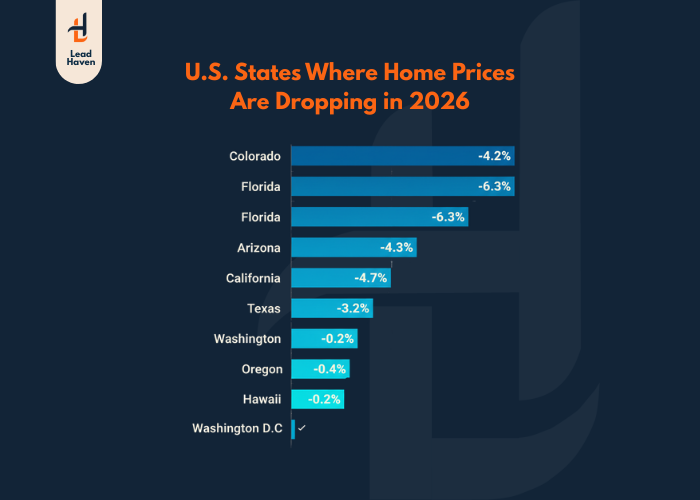
This guide breaks down the top 10 U.S. states where home prices are declining in 2026, the economic and market forces behind the drops, and how buyers can use this information to their advantage.
Why State-Level Home Prices Are Falling in 2026
Before diving into individual states, it’s important to understand a core reality of the 2026 housing market:
👉 Home prices are correcting, not collapsing.
The main forces behind state-level price declines include:
- Affordability ceilings reached after years of rapid appreciation
- Increased housing inventory in suburban and secondary markets
- Slowing population growth or out-migration
- Reduced investor activity compared to previous years
These conditions are not uniform nationwide, which is why state-by-state analysis matters more than national averages.
1️⃣ California
California continues to lead the list of states with falling home prices in 2026, especially outside prime coastal and luxury markets.
Why Prices Are Falling
- High home prices relative to income
- Continued out-migration to lower-cost states
- Rising insurance, tax, and ownership costs
While demand remains strong in select urban cores, many inland and suburban markets are seeing price pullbacks as buyers push back against affordability limits.
2️⃣ Texas
Texas experienced one of the strongest housing booms earlier in the decade. By 2026, that growth has normalized.
Why Prices Are Falling
- Significant inventory growth in major metro areas
- New construction outpacing demand
- Buyers becoming more price-sensitive
This has created buyer leverage, particularly in recently developed neighborhoods.
3️⃣ Arizona
Arizona’s housing market saw rapid appreciation during the post-pandemic years. In 2026, it is undergoing a post-boom correction.
Why Prices Are Falling
- Investor demand cooling
- Supply catching up with earlier demand
- Buyers exercising more caution
Markets that saw the fastest price growth are now seeing the clearest adjustments.
4️⃣ Florida
Florida remains a desirable state, but affordability pressures are reshaping the market.
Why Prices Are Falling
- Rising insurance premiums
- Increased property taxes in some areas
- Slower demand in non-coastal and secondary cities
While prime coastal locations remain competitive, price declines are emerging elsewhere.
5️⃣ Nevada
Nevada’s housing market is closely tied to investor activity and migration patterns.
Why Prices Are Falling
- Investor pullback
- Reduced speculative buying
- Increased inventory in certain metros
This has resulted in price stabilization and decline in markets that previously overheated.
6️⃣ Colorado
Colorado’s housing prices surged faster than income growth in earlier years. By 2026, that imbalance is correcting.
Why Prices Are Falling
- Affordability challenges
- Normalizing buyer demand
- Inventory expansion
Markets outside the most competitive urban centers are experiencing downward price pressure.
7️⃣ Washington
Washington’s housing market is influenced heavily by the tech sector and employment trends.
Why Prices Are Falling
- Employment volatility in tech-driven regions
- Affordability resistance from buyers
- Uneven demand across metros
As a result, some areas are seeing declines while others remain stable.
8️⃣ Illinois
Illinois continues to face long-term demographic and affordability challenges.
Why Prices Are Falling
- Population stagnation
- High property taxes
- Limited demand growth
These factors have contributed to gradual home price declines in many parts of the state.
9️⃣ New York
New York’s housing market is highly segmented. While luxury markets remain resilient, many areas are correcting.
Why Prices Are Falling
- High ownership and carrying costs
- Out-migration from high-cost regions
- Buyer affordability constraints
Price declines are more visible outside premium urban locations.
🔟 Oregon
Oregon rounds out the list of states with falling home prices in 2026, particularly in secondary cities.
Why Prices Are Falling
- Slower inbound migration
- Rising living costs
- Increased housing supply
As demand cools, prices are adjusting to more sustainable levels.
Is This a Buying Opportunity?
For many buyers, yes.
States with falling home prices in 2026 offer:
- More negotiating power
- Reduced competition
- Greater choice in inventory
Buyers are no longer forced into rushed decisions and can approach purchases strategically.
How Buyers Should Use This Information
Focus on Cities, Not Just States
State trends provide direction, but city-level data reveals real opportunities.
Negotiate Beyond Price
In a cooling market, sellers are often open to:
- Closing cost assistance
- Repairs and upgrades
- Flexible timelines
Think Long-Term
Markets experiencing corrections often present the best long-term value, especially for buyers planning to hold property over time.
What This Means for Investors
For investors, falling prices don’t signal risk — they signal entry points.
Smart investors in 2026 are focusing on:
- Cash-flow potential
- Rental demand stability
- Long-term appreciation, not short-term flips
Final Thoughts
The U.S. housing market in 2026 is defined by selective correction, not nationwide decline.
The states listed above represent areas where pricing has adjusted to reality, creating opportunities for informed buyers and investors.
👉 For a deeper breakdown of why these trends are happening and where the best opportunities exist, read our full guide on U.S. states where home prices are dropping in 2026.
✅ SEO NOTES (BUILT-IN)
- Long-tail + buyer intent keywords
- Clear internal link opportunity to pillar page
- Discover-friendly structure
- Evergreen with 2026 relevance